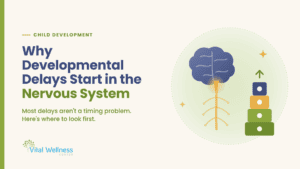
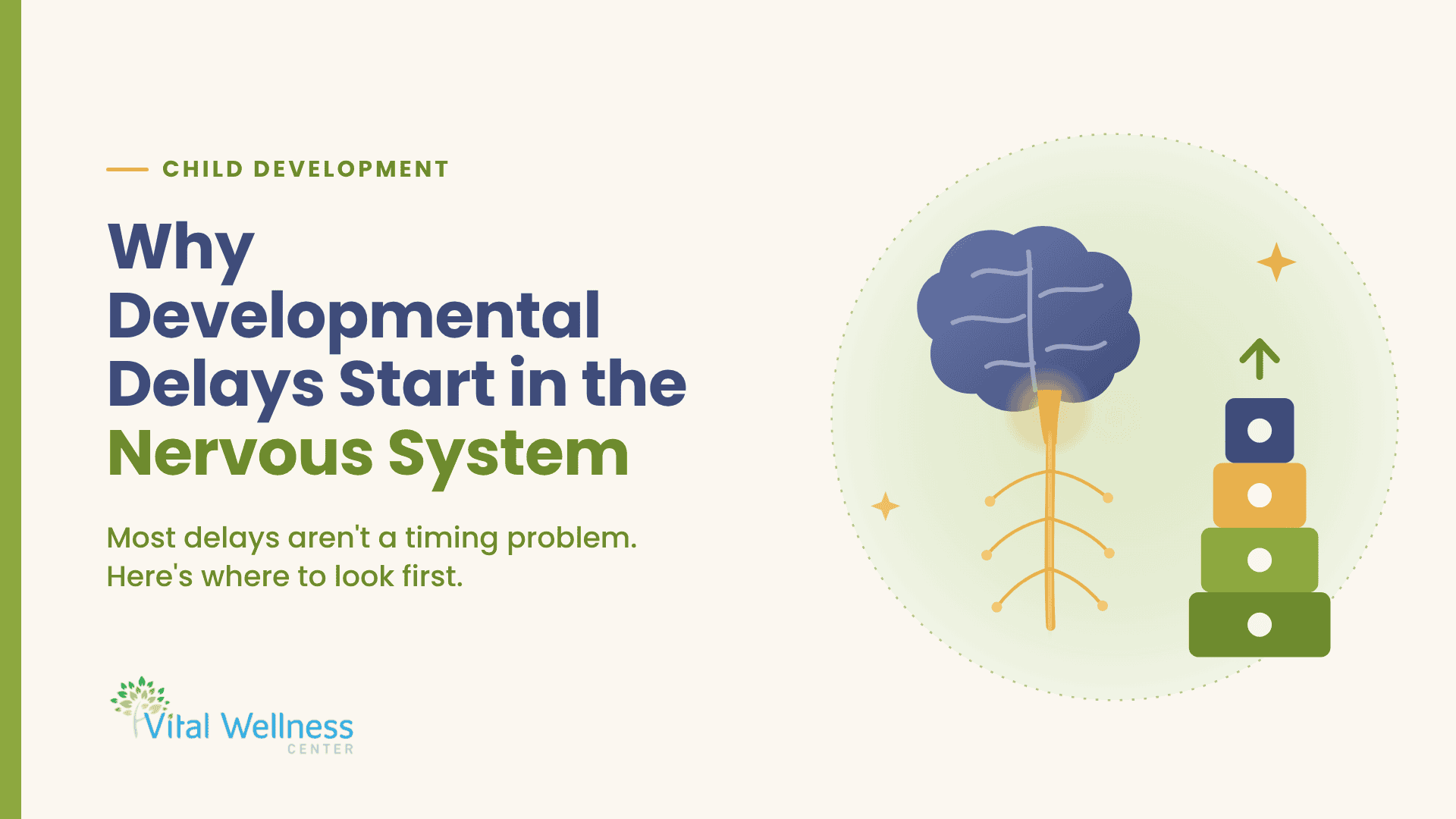
Why Developmental Delays Start in the Nervous System
Your child isn’t hitting milestones the way you expected.
Maybe they aren’t walking yet. Maybe the words haven’t come. Maybe every transition ends in a meltdown, or they’ve never slept well, not even once. And every time you bring it up at a checkup, you hear the same thing:
“Don’t worry. They’ll catch up.”
So you wait. You watch. You compare notes with other moms and Google late into the night. And that knot in your stomach doesn’t go away.
If that’s you, we want you to hear this first: your instincts are worth listening to. You know your child better than anyone. And there’s something almost nobody tells parents in that exam room.
Most developmental delays aren’t a timing problem. They’re a nervous system problem.
When a child’s brain and nervous system get stuck in stress mode, the skills built on top of that system come slowly, unevenly, or not at all. This isn’t about bad genes. It isn’t bad luck. And it is not something you did wrong. It’s a root cause, and root causes can be found.
Let’s look at where to start.
You Are Far From Alone
According to the CDC, about 1 in 6 children in the U.S. has a developmental disability or delay. That’s millions of families being told to wait.
But waiting has a cost. Harvard’s Center on the Developing Child reports that in the earliest years, a young brain forms more than a million new neural connections every second. Pathways that get used grow stronger. Pathways that don’t get used are pruned away.
So the real cost of “wait and see” isn’t the waiting itself. It’s that waiting uses up the very months when your child’s nervous system is most ready to change. Then come the waitlists for an evaluation, and more waitlists for therapy. By the time help finally starts, a big piece of that window has already passed.
You don’t have to sit on your hands in the meantime. Understanding why your child is struggling is the first step toward helping them move forward.
1. Every Milestone Runs on the Same Hardware
Think of your child’s brain, brainstem, and spinal cord as the hardware that runs every skill. Walking, talking, sleeping, playing, learning: all of it depends on this system working well.
The brainstem in particular handles three big jobs:
- Regulation: sleep, digestion, immune function, and the stress response
- Sensory processing: deciding what’s safe and what’s a threat
- Motor development: building tone, posture, and coordination
Picture the brainstem as an airport control tower. When the tower is under stress, flights don’t land on time. Some get delayed, some get rerouted, and the whole schedule falls apart.
That’s why kids rarely have just one delay. If your child struggles with speech, there’s a good chance you’re also seeing sensory struggles, sleep trouble, or tummy issues. These aren’t separate problems. They’re often signs of the same stressed system underneath.
2. The Order of Milestones Matters More Than the Calendar
You can’t build the kitchen before you pour the foundation. Development works the same way.
Your child’s nervous system builds skills in a predictable sequence:
- Sleep and digestion
- Immune function
- Motor tone and coordination
- Speech
- Social and emotional skills
- Thinking and learning
A child who skipped crawling or never slept well may struggle with every step that comes after. On the flip side, a child who’s a little behind but moving through the steps in order is usually doing just fine.
This is good news for parents, because it means the milestone chart isn’t the whole story. In our experience, bigger and heavier babies often reach motor milestones a bit later, and that’s not a red flag. What matters most is whether the foundation is solid and the steps are building on each other.
3. Kids Can’t Grow and Protect at the Same Time
Your child’s nervous system has two pedals:
- The gas pedal drives fight or flight.
- The brake pedal supports rest, digestion, and growth.
Kids are meant to spend most of their early years with their foot on the brake pedal, in calm, safe growth mode. That’s when the wiring for every future skill gets laid down.
But when the gas pedal gets stuck down, the body’s energy goes toward watching for threats. The resources meant for development get spent on survival instead. We call this nervous system dysregulation, or Sympathetic Dominance, and it’s the biggest driver of developmental delays we see in practice.
A child stuck in protection mode isn’t being difficult. They’re doing exactly what their nervous system is telling them to do.
4. The Perfect Storm: How Kids Get Stuck
So how does a child’s nervous system get stuck in the first place? Usually, it’s not one thing. It’s a stack of stressors we call The Perfect Storm™.
Prenatal stress. Stress hormones like cortisol cross the placenta. Think of the umbilical cord as a power cord running between mom’s nervous system and baby’s. (Mama, this is not about blame. Pregnancy is hard, and life doesn’t pause for nine months.)
Birth trauma and interventions. Induction, forceps, vacuum extraction, and C-sections can place real stress on a baby’s delicate upper neck and brainstem. Even “easy” births can leave a mark. In one study, 99 out of 100 healthy newborns showed measurable strain patterns in the head and neck.
Early childhood stressors. Repeated rounds of antibiotics, toxins, illness, and family stress stack on top of everything else.
One stressor alone may not do much. It’s the stack that locks a child into protection mode. And once you can see the stack, you can start to unwind it.
5. Why So Many Kids Plateau in Therapy
Maybe your child is already in speech, OT, or PT. Maybe they made great progress at first, and then everything stalled.
First, know this: that plateau isn’t a failure of the therapy, and it isn’t a failure of your child.
Therapies are designed to train skills on top of a working foundation. But when stress piles up, it creates subluxation, which means misalignment, fixation, and neurological interference between the brain and body. That interference often affects the vagus nerve, which helps run digestion, immunity, muscle tone, and emotional regulation.
Pushing new skills on a stressed system is like driving with the parking brake on. You can press the gas as hard as you want, but you won’t get very far.
Release that parking brake, and the same therapies your child is already doing often start working better.
There Is So Much Hope Here
Here’s what we want every parent to leave with: your child’s brain stays able to change for life. The CDC points out that acting early can help shape a young child’s developing brain circuits, but it is never too late to look at the foundation.
At [INSERT OFFICE NAME], we don’t guess. We test.
We use INSiGHT Scans, technology developed by the Chiropractic Leadership Alliance (CLA), to see how your child’s nervous system is actually working, including how balanced that gas pedal and brake pedal really are.
It’s important to note that this technology does not diagnose medical conditions, and Neurologically-Focused Chiropractic Care is not a treatment or cure for developmental delays or any other condition, not even back pain. Instead, INSiGHT Scans help us track down the root cause of nervous system dysfunction and dysregulation, so we can build customized care plans and adjusting protocols that help shift your child’s nervous system back into a state of balance, regulation, and resilience.
You Don’t Have to Keep Waiting
Your child doesn’t need more labels. They need answers. And you deserve a team that takes your concerns seriously the first time you raise them.
If you’ve been told to “wait and see” and your gut says something more is going on, trust that feeling. Let’s find out together what’s happening underneath.
Schedule your child’s INSiGHT Scan at Vital Wellness Center today.
Every kid counts, and that includes yours.